Mauria
Vainqueur the DragonMauria, the capital of Ishfania and the seat of Brandon Maure’s power, is the decisive urban center of the princess-rescue plot. It is presented not merely as a destination but as the place where conquest, hostage-taking, demon worship, and economic monopoly converge. The city’s fall leaves Ishfania politically vacant yet materially valuable, making Mauria central both to the defeat of Maure and to the question of who will govern the desert afterward.
Definition and Political Setting
Mauria is identified as Brandon Maure’s capital in Ishfania, a region transformed by the catastrophe engineered by the Sablaris. The Sablaris, once a dark elf empire ruling much of the southern continent, Ishfania, and Barin, turned their own dominion into a red desert through a magical cataclysm intended to hasten universal entropy. Brandon Maure, described as the offspring of a demon lord and a dark elf, subsequently took control of the ruins of Ishfania with summoned monsters. Mauria therefore stands within a landscape whose barrenness is political as well as ecological: the desert is the material remainder of an empire destroyed by cultic ambition and then occupied by a demon-aligned successor.
The surroundings reinforce the city’s isolation. Vainqueur Knightsbane sees a large volcano bordering the western sea, badlands cut by arroyos, scarce vegetation, brown soil, and the beginning of an immense red sand desert beneath the southern horizon. A small human village sits at the mountain’s foot, while primitive encampments lie near the desert’s edge. The countryside supplies little livestock or agricultural abundance, but its volcanic strongholds and ruined imperial territory make it strategically important. The gnoll tribes in those encampments had lived under the dread of Furibon, who permitted them to retain their gold only while obeying him; many fled when Vainqueur Knightsbane warred against the lich, and the survivors later sought work at Murmurin.
Maure’s Capital and the Captive Princesses
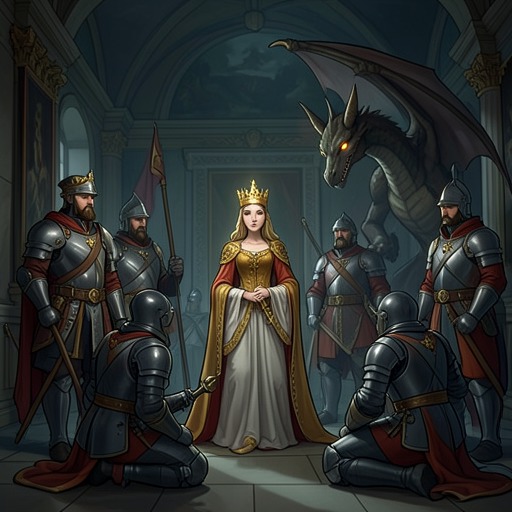
Mauria’s defining institution is Maure’s collection of foreign women as trophies and sacrifices. His victims include imperial princesses from the fallen Sablaris Empire, noblewomen from the Harmonian League, and Princess Merveille, King Roland Gardemagne’s niece. Princess Merveille had been abducted as a child during the war and retained as a political hostage, giving her captivity a diplomatic dimension beyond Maure’s personal appetite for trophies.
The rescue commission is framed as a Gold-rank quest issued by King Roland Gardemagne. The king offers a boon to whoever rescues Princess Merveille, within reasonable limits, but the mission’s apparent romantic or dynastic logic is quickly darkened. The women in Mauria are not being held as brides in a conventional harem. They are captive princesses kept in the capital so Maure can sacrifice them to demons in exchange for power. This practice makes the city a place where aristocratic value is converted into supernatural fuel: lineage, beauty, and political importance all increase the victims’ usefulness to the ruler who imprisons them.
The Covert Approach and the City’s Defenses
Because the prisoners might be moved if Maure learned of the rescue attempt, Vainqueur Knightsbane and Victor Dalton are instructed to travel discreetly. The danger is not limited to an attack on the rescuers. Discovery could cause Maure to evacuate the princesses to an unknown location, destroying the mission’s only reliable lead. Victor Dalton’s camouflage, aided by the Cowl of the Reaper, is therefore treated as practical protection against immediate recognition, while the entire expedition is kept deliberately light.
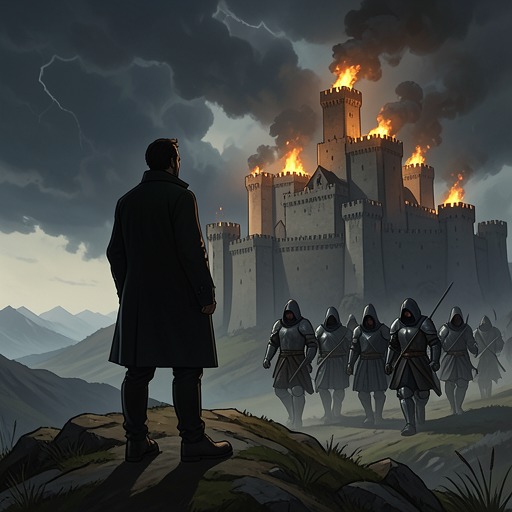
Mauria appears from the desert as a fortress-city built from red, bloody bricks, floating above the sands on greenish stones that generate swirling sandstorms. Its scale is compared to the tallest peak of the Albain Mountains, and flying creatures patrol the air around it. The city’s architecture and supernatural suspension turn it into both a fortress and a spectacle of Maure’s power: the capital does not simply occupy the desert but dominates the sky above it. Its defenses are consequently layered through height, patrols, magical machinery, and the constant threat of hostile fiends.
That security is breached when Vainqueur Knightsbane detects a princess inside the city. His dragon instincts overwhelm the plan for discretion. He turns toward the signal, knocks a knight’s griffon and gargoyles from the sky, and causes a building to fall after striking it. The fiends respond with horns and bells, while Kia calls to him from the sky port and Victor Dalton is drawn into the chaotic pursuit. Vainqueur Knightsbane ignores the warnings and answers only with the single objective that has seized his attention: the princess.
Fall, Succession, and Aftermath
Mauria’s political order collapses when Brandon Maure dies and his army is destroyed. The destruction removes Ishfania as an organized nation, but it does not make the territory worthless. The desert still contains enough resources to attract the Eversun Empire, Barin, or Prydain, raising the prospect of another Century War over the vacuum left by Maure’s defeat. Mauria thus changes from the secure capital of a demon-infested regime into the contested center of a potentially valuable frontier.
King Roland Gardemagne responds by proposing the Gardemagne–Ishfania Mutual Protection Pact. Gardemagne recognizes Vainqueur Knightsbane’s claim to Ishfania as Emperor, turning his territory into an official adventurer state while preserving access to the Adventurer Guild and allowing him to rule according to his own wishes. In exchange, Vainqueur Knightsbane vows that the two countries will never take up arms against one another and will unite against outside threats. Mauria consequently becomes part of a new legal and diplomatic settlement rather than merely the ruins of a defeated enemy.
The city’s violent legacy is not erased by the treaty. Kia decides to go to Mauria because Brandon Maure’s remaining followers still need to be sent downstairs, although her diplomatic immunity prevents her from harming Maure in the paladin manner. Miel, speaking from Heaven’s political and missionary perspective, asks Kia to use her access to the Emperor and Grand Vizier to influence their future decisions, casting her as a potential moral intermediary. Mauria remains therefore an active problem after Maure’s death: its ruler is gone, but his followers, resources, and ideological contamination still require intervention.
Narrative Significance
Mauria embodies the book’s recurring transformation of apparently marginal territory into a prize of sovereignty. It begins as the capital of a demon ruler in the ruins of a destroyed empire, surrounded by desert, hostile creatures, and displaced communities. It then becomes the site of a rescue quest, a spectacular breach of fortress defenses, a military defeat, and finally a bargaining piece in international state formation. The city’s changing status tracks the movement from personal adventure to institutional power.
Its history also exposes the instability of claims based on force. The Sablaris remade the land through catastrophic violence; Maure ruled its ruins through summoned monsters, hostage-taking, and sacrifice; and the postwar powers seek to control the same territory through treaties, recognition, and strategic occupation. Mauria is where those methods overlap. Its significance lies less in a stable civic identity than in the succession of regimes attempting to convert a devastated landscape into authority.